Case Study
Building Two-Person Approval and Fraud Controls Into Your Business Software
By Rohit Menon

An email arrives from a supplier you have paid for years. Same logo, same signature, same tone. They have changed banks, and the letter with their new details is attached. Someone in your finance team updates the supplier record, the next payment run goes out, and the money lands in an account that belongs to a criminal.
This is not a rare story. In its 2025 annual crime statistics, the South African Banking Risk Information Centre (SABRIC) reports that supplier mandate fraud and business email compromise "remained material risks" for businesses, with criminals redirecting payments through fake changes to banking details and falsified supplier information. The same report puts reported digital banking crime losses at R2.4 billion across 110,074 incidents in 2025. Internationally the picture is the same: the FBI's 2024 Internet Crime Report recorded US$2.77 billion in losses from business email compromise in a single year.
Most of the advice you will read about this fraud is about spotting suspicious emails. That matters, but it misses the bigger point. The email is only how the fraud starts. The money moves because one login in your business software was allowed to make the change on its own. At Dev3 Studio, we build finance and operations systems where that is simply not possible.

The Real Risk Is One Account Acting Alone
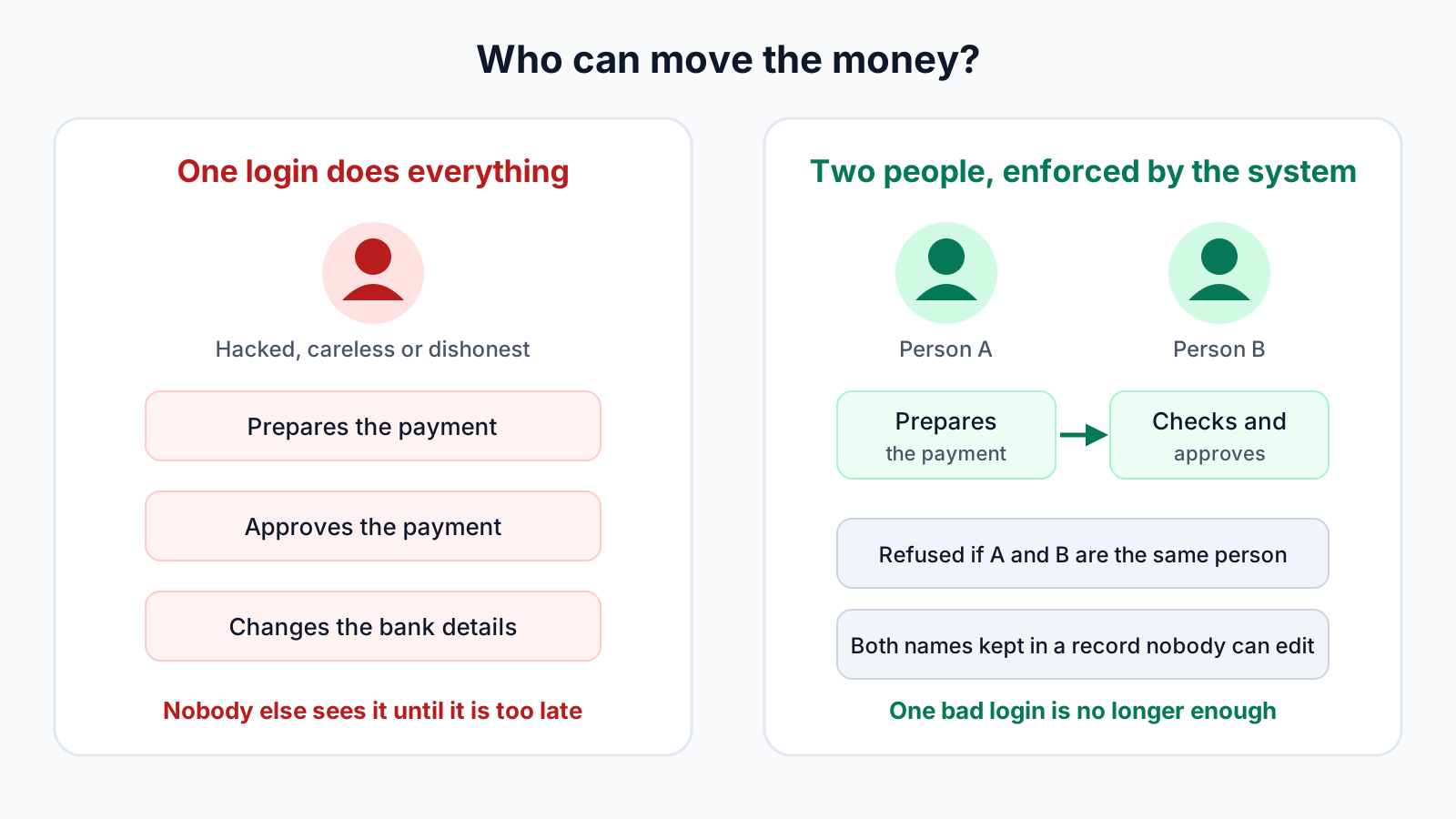
When business owners think about fraud, they often picture a hacker breaking in from outside. In practice, the bigger risk sits inside your own systems: one account that can approve a payment, change a supplier's bank details or edit a customer's contact details without anyone else looking.
That one account might be:
- Hacked. Someone has stolen a staff member's password, or is reading their mailbox.
- Careless. A busy person believes a convincing email and does what it asks.
- Dishonest. A small number of insiders will take the opportunity if it is there.
The software cannot tell these three apart, and it does not need to. If every sensitive action needs a second person, all three are stopped the same way. The Association of Certified Fraud Examiners found in its 2024 Report to the Nations that more than half of the workplace frauds it studied happened because of a lack of internal controls (32%) or someone overriding the controls that existed (19%).
This is what auditors call segregation of duties, or the "four-eyes principle": no single person should be able to start and finish a risky action. Most businesses have this written into a policy document. Far fewer have software that actually enforces it.
The Controls We Build In From the Start
We have built these controls for a South African payments provider that moves money on behalf of employers and the organisations they pay, and for a US online gaming platform we support, where customer accounts hold real balances. The details differ, but the approach is the same: put the rule in the system, not in a memo.
The person who prepares a payment can't approve it
On the payments platform, every payout file goes through two people. One person prepares the file. A different person must approve it before it can go anywhere. The system checks the two identities and refuses the approval if they match. It doesn't rely on a warning message or a manager's reminder.
An unapproved file can't be released to the bank or published to the people expecting payment. If something needs to change, the file is replaced with a new version and the old one stays on record.
The same rule runs through the rest of the system. A person can't review files they uploaded themselves, can't approve a reconciliation they prepared, and can't sign off on a refund they created. The most senior accounts can only be managed by people at the same level, so a junior administrator can't reset a senior colleague's password or security settings and act in their name.
A bank-detail change needs four checks
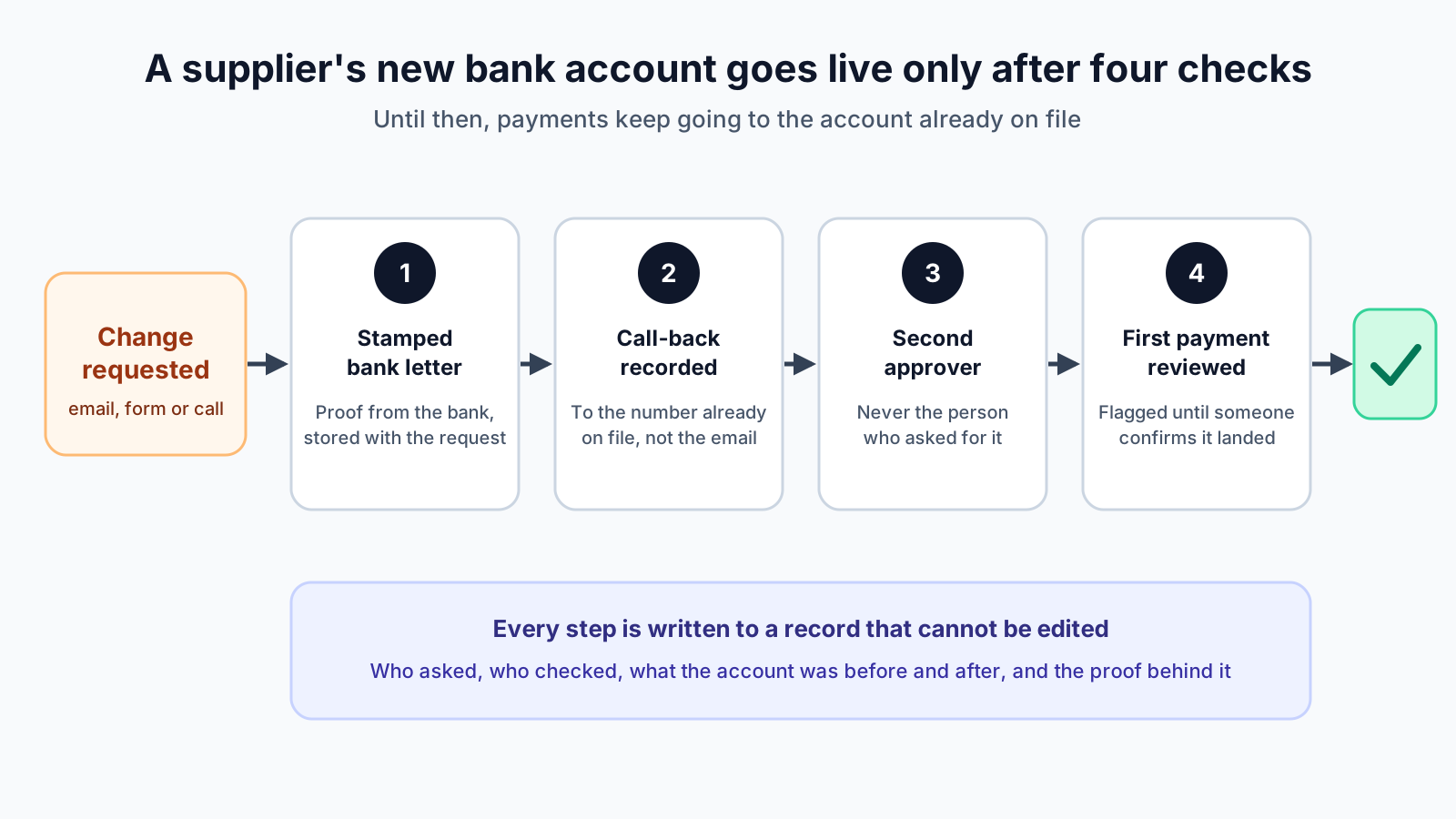
Changing where money goes is the single most targeted action in any finance system, so it gets the strongest protection. On the payments platform, a change to a payee's bank account is a request, not an edit. It only takes effect after four things happen:
- A stamped bank letter is uploaded as proof and stored with the request.
- A call-back to the phone number already on file (never the number in the email that asked for the change) is recorded, including who made the call.
- A second person approves it. The system will not let the person who asked for the change approve it, and this rule is enforced in the database itself.
- The first payment to the new account is flagged for review, so someone confirms that the money arrived where it should.
Until all of that is done, payments keep going to the account already on file. A request can also only be approved against the account it was raised against. If the account was changed in the meantime, the old request can't be approved, so an out-of-date request can never quietly overwrite a newer change. Once a payment plan is approved, its destination accounts are fixed, so a later change can't redirect money that was already signed off.
The exact mix of checks is something we agree with each client. What does not change is that no single person can switch where the money goes.

Changing a customer's contact details protects the customer
Criminals don't only target your suppliers. They also target your customers. If someone can get a customer's email address changed to one they control, they can reset the password, lock the real owner out and withdraw the balance.
On the gaming platform, a change to a customer's email address triggers a set of protections automatically:
- The old address is told straight away. The message says when the change happened, shows the new address partly hidden, and explains how to contact support to reverse it.
- The customer is signed out everywhere. Every active session ends, so anyone already logged in is thrown out.
- Withdrawals are held for 72 hours. For three days after an email change or a password reset, every withdrawal request waits for a person to check it. Nothing is refused; it is simply looked at before money leaves.
- Valuable accounts need a second staff member. If the account has a balance, a verified identity or a withdrawal in progress, a support agent can't make the change alone. They must confirm their own identity again, and a more senior colleague must approve it.
These protections live in the shared core of the system, not in one screen, so every route to the change gets exactly the same checks.
The audit trail can't be edited
Every one of these decisions is recorded: who asked, who approved, when, what the record looked like before and after, and the proof behind it. On the payments platform, that history is protected at the database level. Any attempt to change or delete an audit entry is rejected, even by the application itself. Decided approval requests are frozen in the same way.
This matters for two reasons. If something ever goes wrong, you have a trustworthy account of exactly what happened. And when your auditors ask how you know your controls work, you can show them a record that no one, including an administrator, could have tidied up afterwards.
Controls That Don't Slow the Team Down
The usual objection to four-eyes controls is speed. If every approval means logging into a back-office system, people find workarounds, and workarounds are where fraud slips through.
So we bring the approval to where the team already is. On the gaming platform, requests that need a second person appear as alerts in the team's Slack channel, with Approve and Deny buttons. A manager can make the call from their phone in seconds.
Convenience doesn't weaken the control. The system only accepts a button press from a Slack account linked to an active staff member with the right permission. It refuses a decision from the person who raised the request, the buttons expire after 10 minutes, and every decision is recorded against the staff member's name, exactly as if it had been made in the back office.
We also use AI in our own work around these systems: to help review every route a sensitive change can take before it goes live, to watch for unusual patterns, and to draft summaries when something needs a closer look. People still make the decisions.

What This Means for Your Business
You don't need to be a bank to benefit from these controls. Any business that pays suppliers, runs payroll, refunds customers or holds customer balances has the same exposure. Here is what building them into your software gives you:
- Less money at risk. A fake bank-detail change or a hacked login can't, on its own, send money to the wrong place. South African courts have made clear that this loss usually falls on the business that paid. In Hartog v Daly, an attorney who paid into a fraudster's account after an intercepted email changed the banking details was held liable, while the bank was not, because electronic payments are processed on the account number alone.
- Protection from all three kinds of risk. The same control stops a stolen password, an honest mistake and a dishonest insider.
- Easier audits. Your auditors see the controls enforced and evidenced in the system, not just described in a policy.
- Customer trust. Customers are told when their details change and their money is held safely while it is checked. That is the kind of care that keeps people loyal.
- No extra admin. Approvals arrive where your team already works, so the safe way is also the quick way.

How Dev3 Studio Can Help
We design and build internal tools, finance systems and operations platforms for South African and international businesses. Whether you need a new system or want to add approval controls to one you already use, we start by mapping where money and sensitive data can change hands, then build the checks into the software from day one: maker and checker roles, bank-detail change workflows, customer account protections, tamper-proof audit trails and approvals from your team's chat app.
If one login in your business can still move money on its own, we would be glad to talk it through. Get in touch with Dev3 Studio to discuss your systems.

What is the four-eyes principle?
The four-eyes principle, also called segregation of duties or maker-checker, means no single person can start and finish a risky action on their own. One person prepares something, such as a payment or a bank-detail change, and a different person checks and approves it before it takes effect.
How does fake bank-detail-change fraud work?
A criminal sends a convincing email or letter, often from a hacked or look-alike supplier mailbox, saying the supplier has new bank details. If one staff member can update the supplier record alone, the next payment goes straight to the criminal's account. SABRIC lists supplier mandate fraud and business email compromise as material risks for South African businesses.
Will approval controls slow my finance team down?
Not if they are built well. We send approval requests to the team's chat app, such as Slack, with Approve and Deny buttons, so a manager can respond in seconds from their phone. The system still checks that the approver is an authorised staff member and not the person who raised the request, and records every decision.
Can you add these controls to software we already use?
Often, yes. We start by mapping where money and sensitive data can change in your current systems, then either extend the existing system or build a focused internal tool around it that enforces two-person approval and keeps a tamper-proof audit trail.
Why does an uneditable audit trail matter?
If an audit log can be edited, it cannot prove anything. We protect the audit history at the database level so no one, including an administrator or the application itself, can change or delete an entry. That gives you a trustworthy record for investigations and clear evidence for your auditors.