Case Study
How AI-Assisted Monitoring Protects a New System in Its First Week
By Rohit Menon

Most businesses plan the build of a new system down to the last screen. Far fewer plan the week after it goes live. Yet that first week is when real customers arrive in real numbers, use the system in ways no test ever imagined, and decide whether they trust it enough to come back.
We wrote about the ongoing care every product needs in What Happens After Launch. This article is the deeper, real-world version: how we ran the first two weeks of a large launch for a US online gaming platform we support, and why we now treat every launch as an operation rather than an event.
Why the First Week Decides So Much
A new system is a promise to your customers. In launch week, small things can quietly break that promise: a sign-up that will not finish, a payment that has been taken but has not reflected yet, a page that slows to a crawl when everyone arrives at once.
The owner usually hears about these problems last. Customers rarely write in to explain. They simply leave. PwC's customer experience research found that about a third of customers would walk away from a brand they love after just one bad experience. Speed matters just as much: Google's research found that more than half of mobile visits are abandoned if a page takes longer than three seconds to load.
And when systems do go down, the bill is real. In the Uptime Institute's 2026 outage analysis, 57% of organisations said their most recent major outage cost more than USD 100,000.
None of this means a launch has to be stressful. It means the days after go-live deserve the same planning as the build.

A Launch Is an Operation, Not an Event
For this launch we set up something closer to a control room than a "go live and hope" moment. The goal was simple: notice every problem before a customer has to tell us, understand it properly, and fix it safely.
Doing that by hand, around the clock, for two weeks, would need a large team watching screens in shifts. Instead, we used AI agents to do the watching and the first round of digging, and kept our engineers in charge of every decision.
Here is how the loop worked:
- Watch. Automated agents checked the health of the hosting, the error logs, payments and new customer support messages every few minutes, day and night.
- Flag. When something changed from normal, such as slower responses, a rise in errors or a payment that did not match, the agent raised it. If nothing had changed, it stayed quiet, so real alerts never drowned in noise.
- Draft. For every unusual event or customer query, an agent pulled together the evidence and wrote an investigation report: what happened, who was affected, how confident it was, and what it suggested doing.
- Review. One of our engineers read the report, checked the evidence and decided what to do. Nothing that touched money, customer accounts or system settings changed without a person's approval.
- Act and check. We made the change, and for anything risky we rehearsed it first and confirmed afterwards that every number still added up.
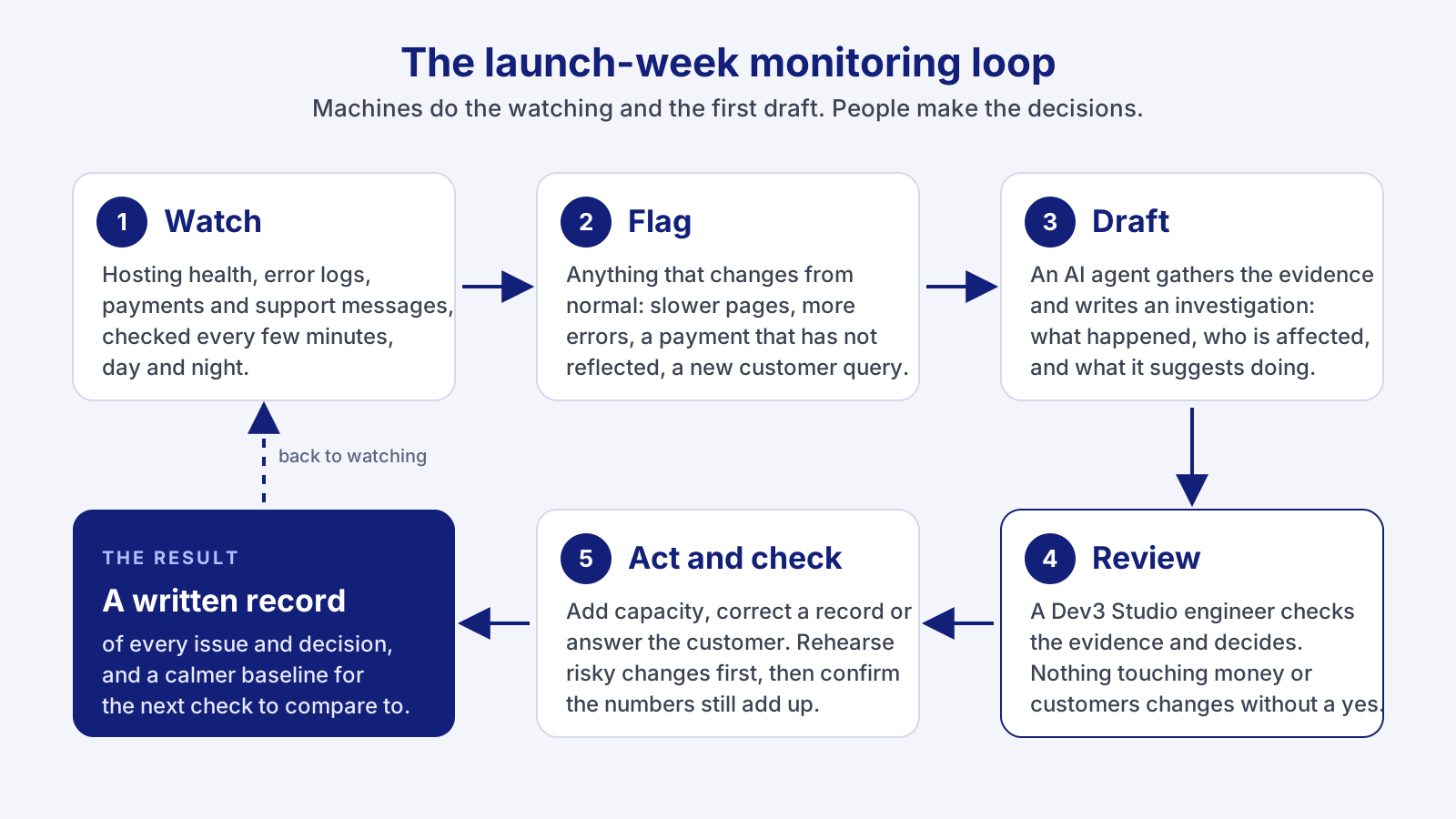
The output was a steady stream of written investigations. In the first 13 days, the process produced about 165 investigation reports, and 61 of those were written on launch day alone. Each one gave our team a head start: instead of spending the first hour of every problem gathering facts, an engineer could start from a clear summary and the evidence behind it.
The support side worked the same way. Roughly every half hour, an agent read the newest customer messages, matched each one against the system's records and logs, and drafted a diagnosis for our team. In one routine run it reviewed more than 130,000 log entries to make sure nothing related had been missed. A customer asking "where is my money?" got an answer based on evidence, not guesswork.
Handling Success: When Everyone Arrives at Once
In the first few hours, sign-ups and activity climbed quickly as customers arrived. That is exactly what a launch is supposed to do, but it puts pressure on the servers. As the busiest minutes hit, the system's main server was running close to full capacity and responses were starting to slow.
The monitoring picked this up straight away, and the decision was made to add capacity. We went from one main server to four. All four were up, healthy and sharing the load about two minutes later. Typical response times dropped back to well under a second, and failed requests fell to a tiny fraction of a percent.
The cost of that extra headroom was modest: roughly USD 100 a month for the three additional servers. We then set the system to grow and shrink on its own within an upper limit the client had approved in advance, so it could absorb the next surge without anyone touching it and without a surprise bill. The monitoring also checked spend once a day and would warn us well before costs approached that limit.
Five days later, a routine six-hour health check showed every service healthy, and fewer than 2 in every 100,000 requests to the main system failed.

Making Sure Every Cent Adds Up
When a system handles money, "it looks fine" is not good enough. In the first week we reconciled every payment and every balance line by line.
Within hours of launch, every payment recorded by the payment provider was matched against the orders in the system: the amount, the currency and what the customer should have received. The check looked for duplicates, for credits on unpaid orders and for any payment that had gone through without being credited. It found one payment the provider had confirmed whose confirmation notice had not arrived in the system. That order was flagged and recovered through the normal, safe payment route, rather than by someone editing a balance by hand.
Later that day we ran a full check of the platform's accounting records: more than 800,000 individual entries. Every transaction balanced to zero, no account showed a negative balance, and there were no orphaned records.

Where a record did need correcting, we followed the same discipline every time. The change was rehearsed against live data and rolled back automatically to prove it did exactly what was intended. Only then was it applied for real, with a full before-and-after record kept. History was never deleted. Corrections were added as new, clearly labelled entries, the way an accountant posts an adjusting entry instead of tearing out a page.
Knowing When Not to Act
Good monitoring is not only about speed. Sometimes the right move is to wait for better evidence.
In the first few days, one of the platform's outside game suppliers was not sending final results for some game rounds, which left a number of customers' winnings waiting to be settled. The AI investigation scanned every affected round across all customers, worked out exactly what was outstanding, and was clear about what it could not yet prove. It recommended against paying out or writing off anything until the supplier confirmed the outcomes.
That restraint protects everyone. Customers are not shortchanged, the business does not pay out money it does not owe, and every decision can be explained later.
What This Means for Your Business
You may not be launching a gaming platform, but the same risks show up in almost every new system: an online shop, a booking app, a customer portal, a new internal tool your staff depend on. Here is what an AI-assisted launch gives you:
- Problems are caught before customers complain. Issues surface in minutes, not when a frustrated customer posts a review.
- Your customers get faster, better answers. Support queries arrive with the evidence already gathered, so the reply is accurate first time.
- Growth does not turn into downtime. When traffic surges, capacity is added in minutes, at a predictable cost you approved beforehand.
- Your money is accounted for. Payments and balances are checked line by line, so you know the numbers are right instead of hoping they are.
- You keep control. AI does the watching and the drafting. Experienced people make every decision, and you get a written record of each one.
- It costs less than a war room. Round-the-clock attention without paying a large team to sit up all night.
For a small or medium business, this is often the difference between a launch that builds trust and one that quietly loses the customers you worked hard to attract.

How Dev3 Studio Can Help
Dev3 Studio builds web apps, mobile apps, dashboards, internal tools and process automation for businesses in South Africa and around the world, and we stay with you after launch. Our launch support, managed hosting and AI-assisted operations cover everything described here: round-the-clock monitoring, written investigations for every issue, capacity that grows with demand inside a budget you set, and careful reconciliation of anything involving money.
If you are planning a launch, or you have a system that is already live and you would like more confidence in how it is being watched, get in touch with us. We will help you plan the first week as carefully as the build.

Why does the first week after launch need its own plan?
Launch week is when real customers arrive in real numbers and find situations no test covered. Small problems such as a sign-up that will not finish, a payment that has not reflected or a slow page are often invisible to the owner until customers complain or leave, so they need to be caught and fixed quickly.
What does AI-assisted monitoring actually do?
AI agents check hosting health, error logs, payments and new support messages every few minutes, day and night. When something changes from normal, an agent gathers the evidence and drafts a written investigation explaining what happened, who is affected and what it suggests. One of our engineers then reviews it and decides what to do.
Does the AI make changes to my system or my customers' accounts on its own?
No. The AI watches and drafts. Nothing that touches money, customer accounts or system settings changes without approval from an experienced person, and risky corrections are rehearsed before they are applied, with a full record kept.
What happens if my new system suddenly gets far more traffic than expected?
We add capacity as soon as the monitoring shows the system is under strain. On one launch we went from one main server to four in about two minutes for roughly USD 100 a month extra, then set the system to scale on its own within a spending limit the client approved in advance.
How do you make sure payments and balances are correct after launch?
We reconcile every payment against the orders in the system and check the accounting records line by line, looking for duplicates, missing credits and anything that does not balance. Any payment that has not reflected is recovered through the normal payment process rather than by editing balances by hand.