Case Study
Scaling a Live System Without Downtime, and Cutting Hosting Costs Along the Way
By Rohit Menon
Growth is what every business wants. But in a business that runs on software, growth often shows up somewhere unexpected first: the monthly hosting bill. Customer numbers rise, and the bill rises faster. Data piles up every day. And the system at the heart of the business slowly becomes something nobody wants to touch, because changing it seems to mean switching it off.
This article walks through how we handled exactly that for a US online gaming platform we support. We restructured its live database while it kept trading, roughly halved its monthly database spend, and did it with zero downtime. The same method also carried a South African payments provider through a major switchover without interruption.
When Success Becomes a Scaling Problem
Most systems are built to launch. That is the right call. Early on, the priority is getting a working product in front of customers quickly, proving the idea, and keeping a complete record of everything that happens so problems are easy to investigate. Storage is cheap when volumes are small, so it makes sense to save generously.
The trouble is that the same design that makes a launch fast can become expensive at real volume. The gaming platform is a good example. To keep a full, auditable trail, every transaction was saved with a large amount of supporting detail, including copies of the settings that applied at that moment. Five weeks after launch, the database already held about 111 GB. As volumes climbed, it was growing by about 9 GB a day at its busiest.
Nobody did anything wrong here. A design built for launch simply met the volume that success brings. But left alone, that kind of growth compounds. More data means bigger storage bills, slower reports, longer backups, and more powerful (and more expensive) servers just to keep up.
It's also a common story. In Flexera's 2026 State of the Cloud survey, cloud decision-makers estimated that about 29% of their cloud infrastructure spend is wasted. If you want a plain-English view of what you are paying for in the first place, our guide to understanding your monthly hosting and cloud costs is a good place to start.
Why Nobody Wants to Touch the Core System
When a business realises its core system needs restructuring, the next thought is usually: "We can't afford to switch it off." That fear is reasonable. In Uptime Institute's 2026 outage analysis, more than half of respondents said their most recent major outage cost over USD 100,000.
For a platform that takes payments around the clock, there is no quiet hour to do maintenance. A traditional rebuild, where you stop the old system, move the data and start the new one, means lost sales, frustrated customers, and the risk that something doesn't come back the way it went in.
So the system stays as it is. The bill keeps climbing. The problem gets bigger and harder to fix with every month that passes.
The answer is not to avoid change. It is to make change safe enough that the business never notices it happening.

How We Restructured a Live Database While the Business Kept Trading
Think of it as changing the engine of a car while it keeps driving. That sounds reckless, but it isn't if each step proves itself before the next one starts. We used four steps.
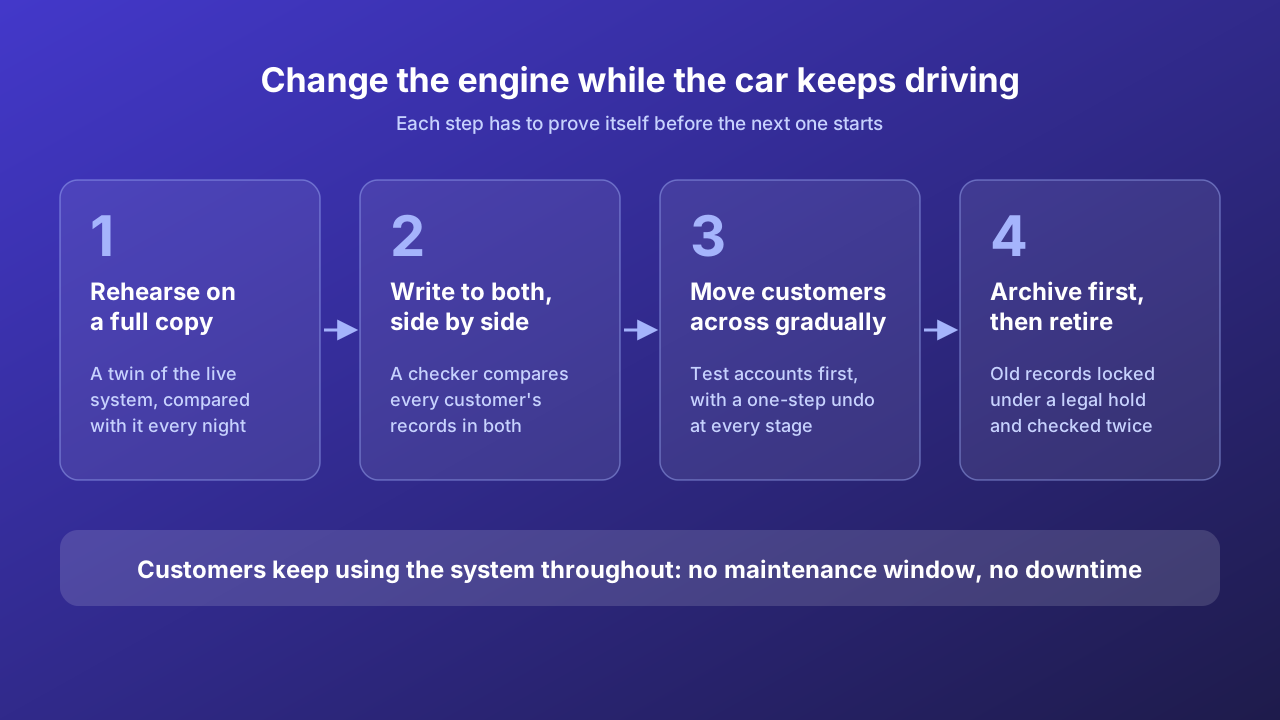
1. Rehearse on a full copy of the live system
First, we created a full working copy of the production database that stayed up to date with the real thing. No customers used it. It existed purely so we could practise. Every night, an automated check compared the copy with production, table by table, and raised an alarm if anything differed.
On that copy we ran every step of the plan before doing it for real: building the new structure, filling it with history, switching test accounts across, and switching them back again. By the time we touched production, each step had already been done end to end.
2. Write to the old and new versions side by side
Next, the live system started saving every new transaction twice: once in the old structure and once in the new one. A separate checker continuously compared each customer's records in both versions, looking for any difference in balances or history.
This is what makes the change safe. The old version stays the source of truth until the new one has shown, over weeks of real traffic, that it agrees with it.
3. Move customers across gradually, with a one-step undo
We didn't move everyone at once. Internal test accounts went first, then customers in stages. At every stage there were two ways back: we could return a single customer to the old version, or switch everyone back at once. Both were rehearsed on the copy before go-live.
Even the final switch had safeguards built in. The system itself refused to stop writing to the old version until everyone had been on the new structure for a sustained period, the comparisons over that period were clean, and the owner's sign-off was recorded.
4. Archive safely before retiring anything
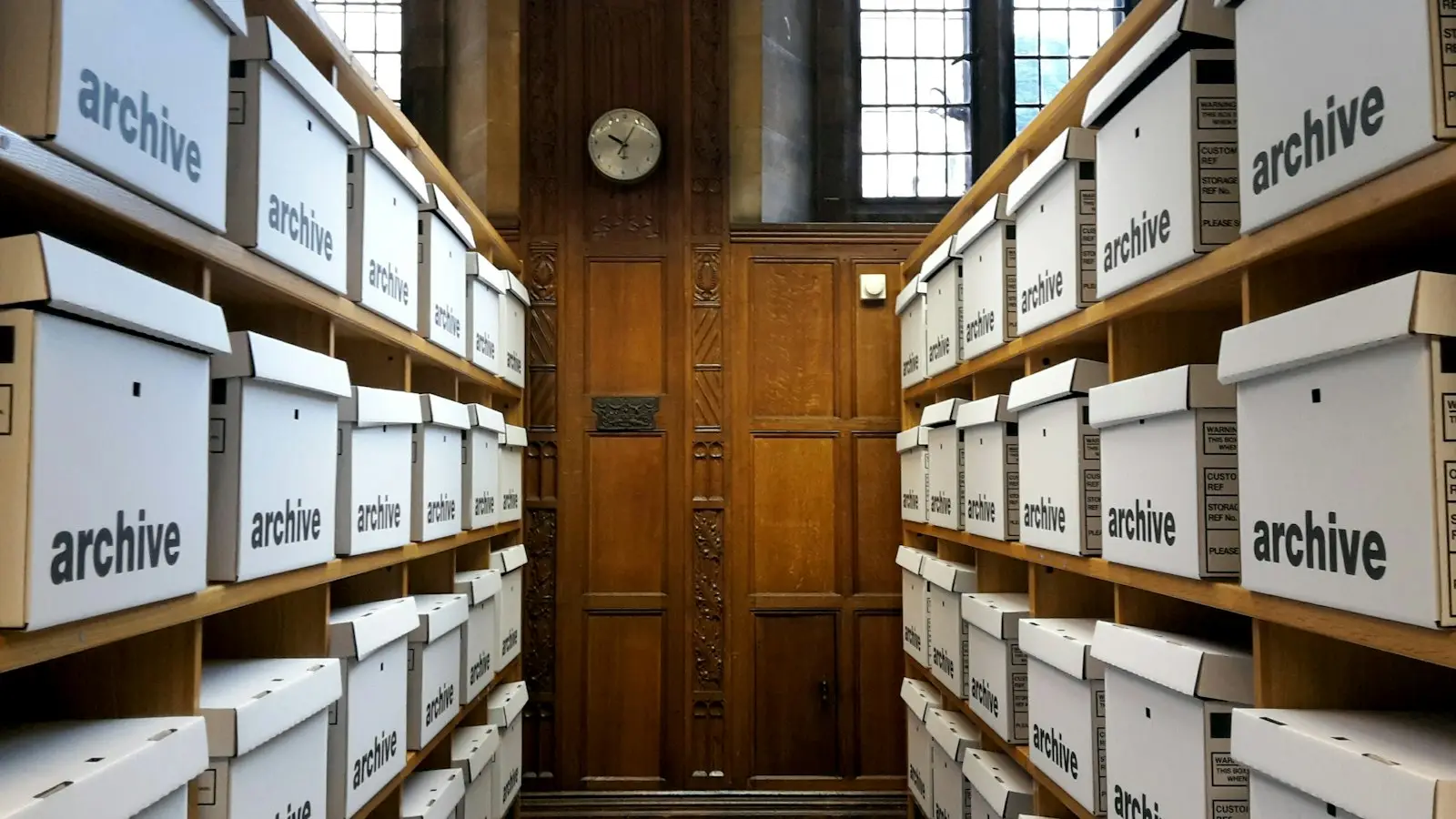
Records in a regulated business cannot simply be deleted because they are no longer needed day to day. Before any old data was retired, it was exported to locked storage under a legal hold, which means it cannot be changed or deleted while the hold is in place. A separate check then re-read every file to confirm it matched what was exported. Only after that was the old data removed from the expensive live database.
The Results
We measured the outcome from the cloud provider's own metrics on 20 November 2026:
- Database size: down from a peak of 406 GB in late October to about 155 GB.
- Daily growth: down from about 9 GB a day to about 0.5 GB a day.
- Monthly database spend: roughly halved, from about USD 3,150 in October to about USD 1,450 at November's pace. October's figure includes the cost of running the rehearsal copy and both versions side by side, so we describe the saving as roughly half rather than an exact number.
- Downtime: none.
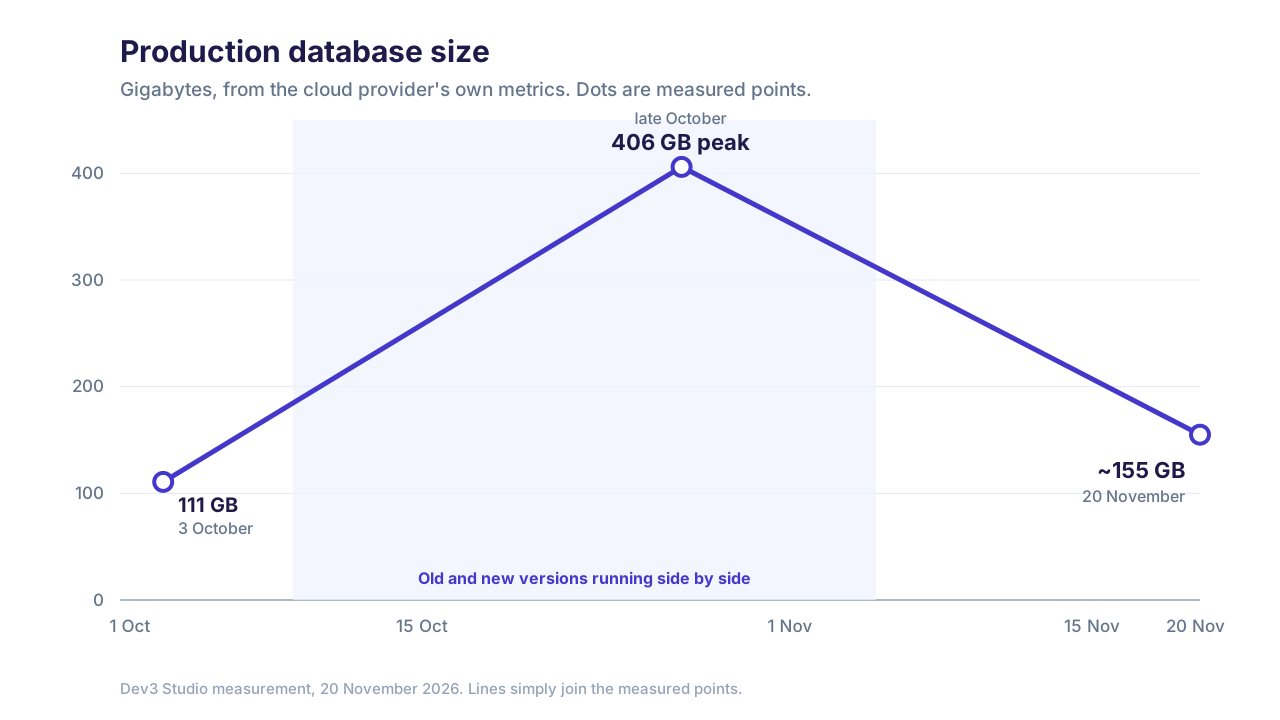
The slower growth matters as much as the smaller size. At 9 GB a day, a database adds more than 3 TB a year. At 0.5 GB a day, it adds less than 200 GB. That is the difference between a bill that keeps climbing and one that stays predictable as the business grows.
The Same Method, a Different Business
The rehearse-first approach isn't specific to one client or one kind of system. When a South African payments provider we work with needed to change how its system processed monthly deductions, we followed the same pattern.
Before release day, we rehearsed the whole change against a copy of production data. We ran read-only checks to preview exactly what the change would do to real records, took three separate backups, set a clear order for updating each part of the system, and prepared a plan for rolling back each step. The rehearsal let us spot old record formats that needed tidying up and clean them up safely in advance, so the release itself was uneventful.
The switchover caused no downtime, and the system has had none since go-live.
Where AI Fits In
We use AI throughout this kind of work, openly and under close human review. It helps us analyse large volumes of database statistics to find where storage and cost are going, investigate any mismatch the checkers raise, monitor the system around the clock, and draft the detailed step-by-step runbooks our team reviews and follows. Every change to a live system is still decided, checked and approved by people.

What This Means for Your Business
You don't need to run a gaming platform or a payments company for this to apply. If your business runs on a web app, an online store, a booking system or an internal tool, the same pattern shows up as you grow. Here is what a careful restructure can give you:
- Lower, more predictable running costs. Storing only what you need in expensive live systems, and archiving the rest, can cut hosting bills significantly and keep them from climbing every month.
- No lost trading. Customers keep buying, booking and paying while the work happens. There is no maintenance weekend and no "we'll be back soon" page.
- Less risk. Every step is rehearsed on a copy first and can be undone in one step, so the real system is never in an unknown state.
- Records you can stand behind. Old data is archived intact and locked, which matters for audits, disputes and regulations such as POPIA.
- A system you can keep building on. Once the core is no longer frozen, adding features and handling more customers becomes routine again rather than a risk.
A few warning signs suggest it might be time to look at your own system: your hosting bill grows faster than your revenue, reports and backups take longer every month, or your team avoids changes to the core system because "it might break something".

How Dev3 Studio Can Help
Dev3 Studio builds and supports web apps, mobile apps, dashboards and internal tools for businesses in South Africa and internationally. We help growing businesses get their cloud and hosting costs under control and modernise the systems they depend on, without taking them offline.
We can start with a review of your current hosting costs and database growth, show you where the money is going, and propose a step-by-step plan with a clear way back at every stage. If you'd like to talk about your system, get in touch with us.

Why does my hosting bill grow faster than my business?
Systems built to launch quickly often save a lot of detail with every transaction. That is sensible at small volumes, but as you grow, the data and the servers needed to handle it can grow faster than revenue. Restructuring how data is stored, and archiving what is no longer needed day to day, brings the cost back in line.
Can a live database really be restructured without downtime?
Yes, if every step is rehearsed first. We rehearse on a full copy of the live system, write to the old and new versions side by side while a checker compares them, move customers across gradually with a one-step undo, and only retire old data once it is safely archived. Customers keep using the system throughout.
What happens to old records when they are removed from the live database?
They are exported to locked, lower-cost storage under a legal hold, so they cannot be changed or deleted while the hold is in place. Every exported file is checked again before anything is removed from the live system, so your records stay intact for audits and disputes.
How much can restructuring save on hosting?
It depends on the system. For a US online gaming platform we support, monthly database spend roughly halved, from about USD 3,150 to about USD 1,450, and daily data growth fell from about 9 GB to about 0.5 GB. A review of your current costs and growth shows what is realistic for you.
Do you use AI for this kind of work?
Yes. We use AI to analyse database statistics, investigate any differences our checkers find, monitor systems around the clock and draft step-by-step runbooks. Every change to a live system is still reviewed and approved by our team.